817 wx. at 6350′ in Carnelian Bay: 36.3°F / 31.3°F dew point / 82% RH / .06″ liquid precip in past 24 hours
0515: wx. at 8650′ TH in Mt. Rose area: 24°F / dense fog / light to mod NE winds
0613 wx at 9880′: 22.9°F / 22.0°F dew point / 98% RH / NE winds between 10-20mph
Backcountry obs.:
This morning dense fog and moderate NE winds ruled the backcountry. Between 4″-8″ of new snow accumulated above 8700′ in the last 48 hours. The saturated airmass, coupled with moderate NE winds has rimed trees and added density to the new snow, making it slow and grippy on the decent. Sharks still abound and are difficult to identify amidst the highly trafficked surface and new snowfall partially filling old tracks.
The Mt. Rose backcountry has gotten quite a bit of action over the past week, despite an early season snowpack; it’s really the only place in North Lake with usable snow. The recent warm, low end storms have left anywhere from 6″ to 2’+ of base depending on elevation and aspect, with 9000′ serving as a solid line of demarcation for usable snow.
Weather and forecast thoughts:
Today (11/21) begins a stretch of clearing and calm late fall weather through Thanksgiving (11/28). Today skies will begin clearing out with temps remaining fairly chilly: below freezing above 8000′ and flirting with 40 at lake level. The weekend will start out cool, but temps warm a bit each day into the beginning of next week under mainly sunny skies. Expect highs in the 30s to low 40s around 8000′ with lows well below freezing each night. A drier airmass and good radiational cooling should help preserve the new snowpack starting this weekend through next week.
Looking out past Thanksgiving, models do signal the possibility of a colder storm developing the weekend after. It’s a long way off, but model ensembles seem to be latching onto this possibility.
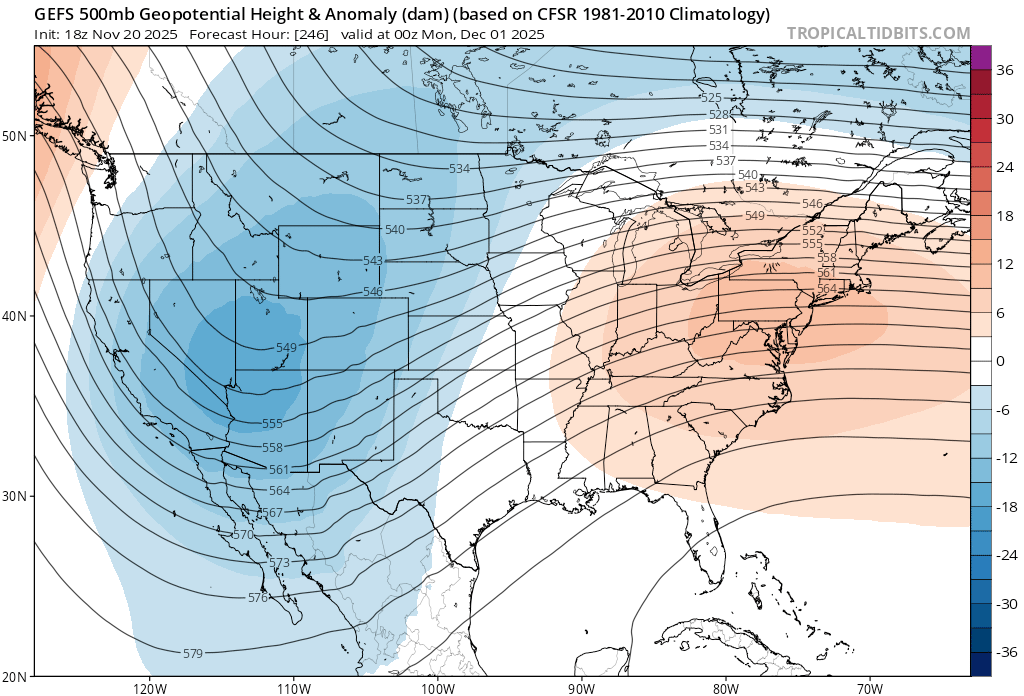
One item to note with this map is the position of the trough over the Great Basin. Setups like this often bring cold storms, but with less abundant precip. The cold air dropping down over land isn’t able to pick up abundant Pacific moisture, so storms tend to have less available juice to work with, but also trend colder. Should this scenario pan out, expect low snow levels (5000′ or lower) and cold, low density snow.
Looking at the long range, there are some indications that the pattern may get stuck around the beginning of December. The Arctic Oscillation (AO) may weaken considerably going negative, thus allowing polar air to spill southward to the mid-latitudes. This far out there’s much uncertainty about how a negative AO might play out, but it typically leads to a continental dipole with one side of North America in the deep freeze under a deep trough, while the other side of the continent sits under an amplified ridge of high pressure hosting mild, storm free weather. More often than not, the West ends up under the ridge.
Right now models are mixed. A strong negative AO this time of year is uncommon. The atmosphere is also still transitioning from summer to winter. These variables help support the fact that variability is at a max, lending to mixed model solutions.
As always, time will ultimately tell. If the trough axis develops too far to the east over the Rockies, then moves out over the eastern 2/3 of N. America, expect dry weather and mild temps. But if it develops 500 miles to the west, that could put Tahoe in line for cold weather and more storms.
For now, it’s time to enjoy snow up high, good trails down low, and awkward conversation over holiday dinners.
 Tahoe Backcountry Snow